

Like most of you, I became indoctrinated into the Cult of Team Cherry about 8 years ago. Oh, I had my quibbles with Hollow Knight, I concede. All of my recommendations to friends were couched in the careful “wonderful-but-there’s-a-catch” tones one reaches for while trying to explain a flawed masterpiece. But the game was the most important Metroidvania of its time – and perhaps the third most important for the genre, behind only Super Metroid and Castlevania: Symphony of the Night.
So, like most of you, my wait for Silksong moved through the Five Stages of Grief, and then backwards, and then repeated a few times. When the clown memes were exhausted and a release date was finally provided, my vacillating hype settled to a satisfied simmer. I was not expecting the game to wow me in the same way that Hollow Knight did, but I did expect a personal Game of the Year experience.
Unlike most of you, that isn’t what I got.
Yes, henceforth, you may consider me a Team Cherry apostate. And for the record, it isn’t their fault that their little indie-series-that-could became such a cause célèbre for a thirsty fandom. They didn’t ask to be manic pixie dream developer, and this isn’t about that. I applaud their standing in modern gaming, a beacon for what a small team can do. Their insistence on not inflating their game’s price “because everything costs more” isn’t simply consumer friendly, it’s the right antidote for this bloated industry.
The tragedy of Silksong is that Team Cherry’s exceptional ability to make art seems to have entirely swallowed their capacity for designing a world around it.
“I remember at some point I just had to stop sketching, because I went, ‘Everything I’m drawing here has to end up in the game. That’s a cool idea, that’s in. That’s a cool idea, that’s in.’ You realize, ‘If I don’t stop drawing, this is going to take 15 years to finish.’”
-Ari Gibson, via Bloomberg
Pretty games start in sketch pads, but great games are not built in them. They are created via a particular alchemy – the dark art of turning digital action into a form that feels uncannily mechanical, and designing a damn good sandbox to house it. It is this last bit that eluded this project, because that? That requires real editing. Silksong’s world of Pharloom should be a wonderful land to explore, considering the boffo success of its predecessor. Alas, our intrepid developers didn’t learn from that success, and instead leaned into the type of direction that can only come from being a bit high on your own supply. “All my cool ideas go in” is a nice working philosophy if all of your ideas are, indeed, cool. Better to have a surfeit of a good ideas rather than the alternative. But that wonderful creative freedom curdles into hubris when you’re a bad editor.
I don’t recall anyone thinking grunts that deal extra damage, meticulously placed foes that interrupt platforming flow, festooning the proceedings with death spikes, or boss runbacks were what Hollow Knight surely needed more of. You have to lock yourself away from the world and believe you don’t need no stinkin’ editor to talk yourself into this much bad game design. No, not “difficult.” Bad. Difficult game design challenges you; bad game design wastes your time. And hoooo boy, does Silksong waste away the hours.
It all starts with your health. Hornet, our hero, doesn’t require much in-game material (or onscreen time) to heal herself. Unfortunately, an imbecile designed the damage calculations for her. A quite robust rogue’s gallery does 2 points worth of health damage in this world. With your starting 5 points of health, that ends your fun in 3 enemy hits. So one might think you’d upgrade health with a certain degree of alacrity. Instead, it takes hours to get your 6th health point, at which point you can…still die in 3 hits. And if you’re thinking that the player would get a steady series of offensive damage upgrades to offset this lack of balance, you…would be in the mind of a gameplay-centric developer. Not one that draws cool shit and throws it into an ever-expanding pot that, goshdarnit, is definitionally full of killer ideas due to who made ’em.
And then there are the runbacks. As a Monster Hunter connoisseur, I’ve never had a problem with getting my ass handed to me and either going back for more, or starting over from scratch. But after a few dozen – hell, it may have gone into the triple digits – runbacks to The Last Judge, I was ready to leave Pharloom and never come back. That I did wasn’t a testament to Team Cherry’s craftmanship, it was instead a landmark to my own idiocy for not recognizing a head-first dive into a sunken-cost fallacy. You have to be a sadist to hide your boss’s RNG garbage behind a platforming section that wastes your time by waiting for the wind to stop blowing. And you have to be a damn fool to keep wasting your time on such a broken, meaningless task.
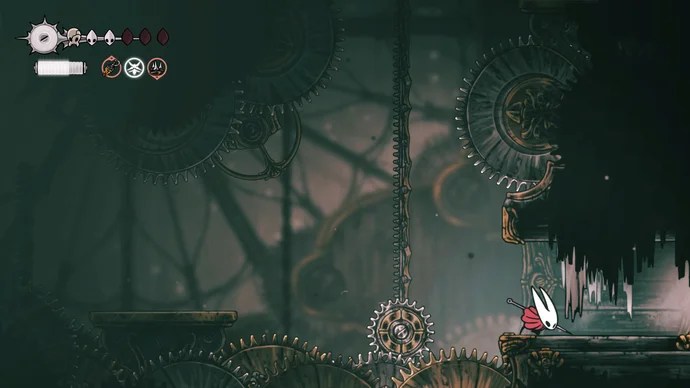
And yes, I grok the heavily-winked religious satire here. Sure, the NPCs in-game pilgrimage intertwines with ours as players. Suffering and failure are the order of the day. Saying “that’s what makes it great” is a bit like saying watching fingernails being pried off of a pinky makes Midnight Meat Train a good movie. It doesn’t. As theodicy goes, this is thin gruel.
The reception to this game is filled with Hope, Cope, and Nope.
The Hope of Silksong was for it to stand shoulder-to-shoulder with Hollow Knight. That it did not would be understandable, but for the nearly-Zelda-length development period, which ended up creating the type of flawed indie game that Team Cherry sidestepped 8 years before.
The Cope? It relies on the somewhat delusional idea that your virtual suffering truly means something. The most absurd claim I read (which I will not link here; it doesn’t deserve it) about this game was that its difficulty was responsible for making the writer more resilient to life’s misfortunes. Trust me, when you have a parent taken off of life support and gurgling their last breath, successfully pogo-ing off of a virtual spike doesn’t mean anything. Defeating Trobbio won’t help your divorce, either, for what it’s worth.
The Nope? Well, you’re reading it. It has existed in Steam reviews and assorted sundry player comments since launch, but has been drowned out by a consensus borne of cowardice. Treating a game this hard with kid gloves is the weakest of weak sauce. As I peruse Metacritic, I see a paltry two mixed reviews. Two. Critics are guilty of playing follow-the-leader, but you don’t see this type of groupthink unless writers get scared of the “git gud”-crowd of online trolls. The fawning is kind of embarrassing. Authoritative sources, being objective and not bullshitting their audiences to the very real flaws here? Nah. Why bother? Who wants to grapple with an uncomfortable reality when you can hide behind the herd?
And really, what could be more 2025 than that?


Leave a Reply