
I once took lessons from a great musician, in my journey to learning how to play a guitar worth a damn. He had the ability to pick up anything with six strings and put your jaw on the floor within 20 seconds. Like clockwork, as I visited every Wednesday at 6:30 after dinner, he’d improvise something – bending, sliding, hammering-on, pulling-off, meandering through a series of notes, turning them into dazzling phrases, a self-contained solo. These weren’t warm-up exercises, or a series of memorized hot riffs. I’d sit there before my lessons, wishing he would just go on and on. But he never did. He played something to loosen up, and then it was down to the business of teaching.
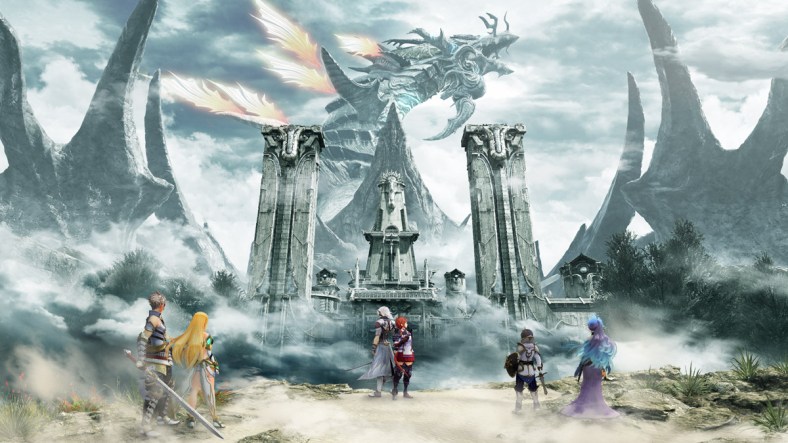
Torna: The Golden Country reminded me of those moments. It is there in a vivid whirl, an exclamation in the ether, and then it is gone just as quickly.
Up until this point, Monolith Soft had shown they could be that sort of master of their craft, but only with a buy-in. You had to accept their eccentricities, their dense plots, their labyrinthine gameplay mechanics. The payoff was worth if, of course. For me, I rank the original Xenoblade in my top-five of all games ever created. But it also took me five years to gain that appreciation, starting and restarting the game, trying to wrap my arms around something that I wanted to love, but could not truly embrace. At first, at least.
Torna is not like that. It is an expansion of Xenoblade Chronicles 2, yes, but it also acts as a prequel and standalone game, one that is the JRPG equivalent of someone on a fuzzy wine drunk, hugging friends and strangers alike. It is immediately accessible in a way the prior games in the Xeno-verse were not. Alex and I once discussed what would happen if Monolith actually made a game that was truly intelligible to the masses. What if they trimmed their excesses, and refined their core design into something that could be appreciated by lovers of all games, not just RPGs? This adventure comes close to answering that question.
The world building occurs here naturally, not as thundering an opening as the original, nor as glacial as XBC2’s overture. Character introductions occur at well-timed intervals to keep the large cast manageable, while simultaneously delivering a bit of fan service for anyone who has adventured in Alrest before. The overall plot is as Sharpie-licking bonkers as you’d expect from Monolith, but it’s toned down from the shōnen leanings of the game upon which it expands.
None of that would matter if the battle system was still as needlessly dense as in prior games. First, a brief primer, for the uninitiated, on how a Monolith joint plays circa 2018. You control your character(s) in real-time; they auto attack as in an MMO; you time button-presses during those auto attacks to build up special attacks; you then have control over when (and where) to unload those special attacks on the battlefield. So far, so good.
The original just couldn’t shut up, insisting on introducing new mechanics to you for dozens and dozens of hours. XBC2 kept combat too simple, and refused to spread its wings for most of its opening act…which gave way to speed-barfing out a scarcely comprehensible balancing act between Driver combos (physical attacks by your human/Driver character) and elemental combos (Captain Planet-ish earth-fire-wind-water-heart attacks by the Blades, who are your Drivers’ partners). I played most of 2 focusing entirely on elemental combos and came out none the worse for it. There was breadth to XBC2’s system, but little depth. Not so in Torna. Monolith finally cracked it here. You are introduced to Driver combos first, and the hook for them was truly a stroke of genius – you initiate “break” status by using a character art, and “topple” is triggered by switching over to control your Blade. I admit that when I first heard that we would be controlling two characters, I thought it sounded like yet another overwrought Monolith complication. But it isn’t. Having access to two characters makes Driver combos second nature – you pull them off in battle in the natural course of tagging out a character getting low on HP. Once you do so, perhaps an NPC in your party will initiate “launch” or “smash”…or maybe you have another Blade in your arsenal you can switch to that could do it instead…or maybe you just leave the monster in question in “topple” status and move to elemental combos. The key is “break” and “topple,” to put your enemy down on the ground, where you can maul the living hell out of them.
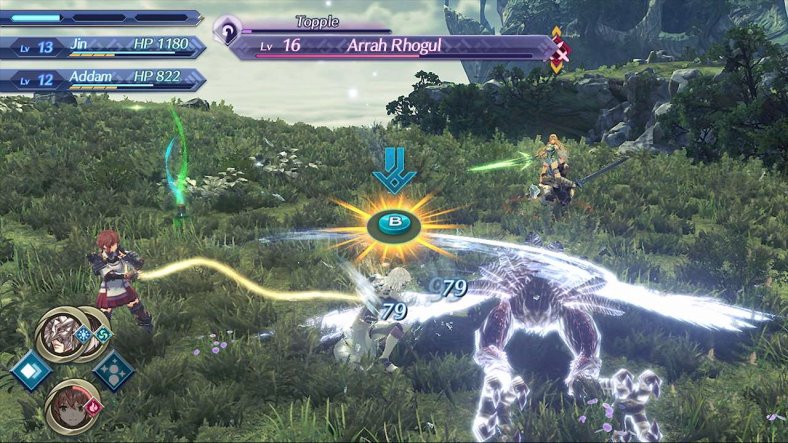
Which is where you really should be switching to elemental combos. In XBC2, these had to follow a prescribed, color-coded path. If you chose wrong, or didn’t have a blade of the required element, the entire opportunity was wasted. Torna beautifully streamlines this to a matter of degrees – once you’ve built up a level I special, you can follow it up with a level II (and then level III) of any color/element. You never waste a combo, unless you’re truly getting your ass handed to you and haven’t built up level II and III attacks. Trigger prompts appear onscreen so that you can choose when to unleash your NPC party members’ elemental Blade attacks, turning you into a maestro of pain.
So. Once you’ve knocked an enemy down with a Driver combo, you begin hitting them with elemental damage. This natural interplay is called a Fusion combo – a monster suffering from “topple” who is hit with a fire or wind attack receives extra damage. The elemental damage you’re doing manifests as a color-coded orb hovering over the enemy (red for fire, blue for water, etc.). If your party is doing well in battle, that fills up an overall party gauge. Once the party gauge is maxed out, you can cash in a chain attack, which allows you to hit those color-coded orbs attached to the baddies for even more extra damage (attack a water orb with a fire attack for extra damage). The catch? If any member of your party falls in battle, you can revive them – but only in exchange for taking a third of your party gauge, and thus your ability to chain attack.
It’s a beautiful battle system, far more elegant than the game upon which it is based, but also requiring more attention than the “spam arts and manage heals” system of the original.
That’s a lot of words spent purely on a battle system, I realize. Trust me, though, this works. And this was what Monolith needed to finally nail. We all knew they could create wondrous worlds. We all knew they could tell an epic story. But up until now, those lands and those tales were hidden behind combat that could lose even the most seasoned gamers, who didn’t have 80 spare hours to pour into a game over a few weeks’ time, lest they forget the whole damn system. It took Monolith Soft almost a decade to finally get it just right. Perhaps they had to learn the hard way, but learn, they have.
So what does that leave us with? A gorgeous world worth exploring. Musical compositions worth listening to on headphones. A tale that nips and tucks the excesses of XBC2 to hit a sweet spot for young and old alike. It’s all desperately pretty, aurally sumptuous, and it might kick you in the feels a bit by the time the credits roll.
Which happens in a scant 20 hours.
Don’t get me wrong, a lot happens in those 20 hours. The critic in me can’t tell you that it’s all roses – the performance takes a hit in handheld, and the endgame is gated behind subquests – but the good so far outweighs the bad that it almost feels like cheating to end so abruptly. I won’t spoil the sights you’ll see, or the adventures you’ll go on, but I can tell you that there aren’t enough of either. You can stretch things out by completing affinity charts for your characters (where the game stealthily hides its more list-like, “kill X number of bear asses” MMO questing), which might add another 10 hours. You can tack on another 10 hours if you really, really, really want to drink in all of the lovely scenery. But the core game ends at 20 hours. For a more action-centric game, that can feel like plenty. Here? Not so much. This adventure is methodical, in the joyful way a summer sunset takes its time hiding behind the horizon. And before you know it, it’s gone. The story says all that it needed to in that space, yes, and that running time is more than fair for a game that is really a giant piece of DLC. That doesn’t stop Torna: The Golden Country from feeling like the opening melodies of a far greater composition.
The type I used to hear every Wednesday at 6:30 in the evening.
 Game Witness