

Never meet your heroes.
I had avoided it, but not because I had thought it would let me down. No, I knew Symphony of the Night would be interesting. Games of this stature don’t get their status by merely being decent. I was more afraid that I’d meet my hero, appreciate it on an academic level, but be left at a cold distance. “Oh yes, I see how this was the bare melody that would blossom into song in later releases.”
You see, I was worried that the most crucial game in the Castlevania series would be less fully realized, and more of a hodgepodge conglomeration of influences. And honestly, that is partially true. This is a work in which the creators’ collective reach exceeded their combined grasp. But my oh my, that breadth. What an inspired arc.
It’s worth mentioning that, contrary to popular belief, Koji Igarashi and Toru Hagihara weren’t setting out to even create a so-called Metroidvania here:
“I was actually surprised by the name. In my heart, I really wanted to create a Legend of Zelda style game. But I suppose that when you turn Zelda into a 2D platformer, yes, it resembles Metroid.”
https://www.usgamer.net/articles/gdc-2014-why-koji-igarashi-is-grateful-for-the-word-metroidvania
That…isn’t…accurate, by the way. Super Metroid’s structure is distinct from A Link to the Past or Ocarina of Time. If the goal was to make a Zelda game, outside of a tacked-on “dual world” theme, they did not succeed here.
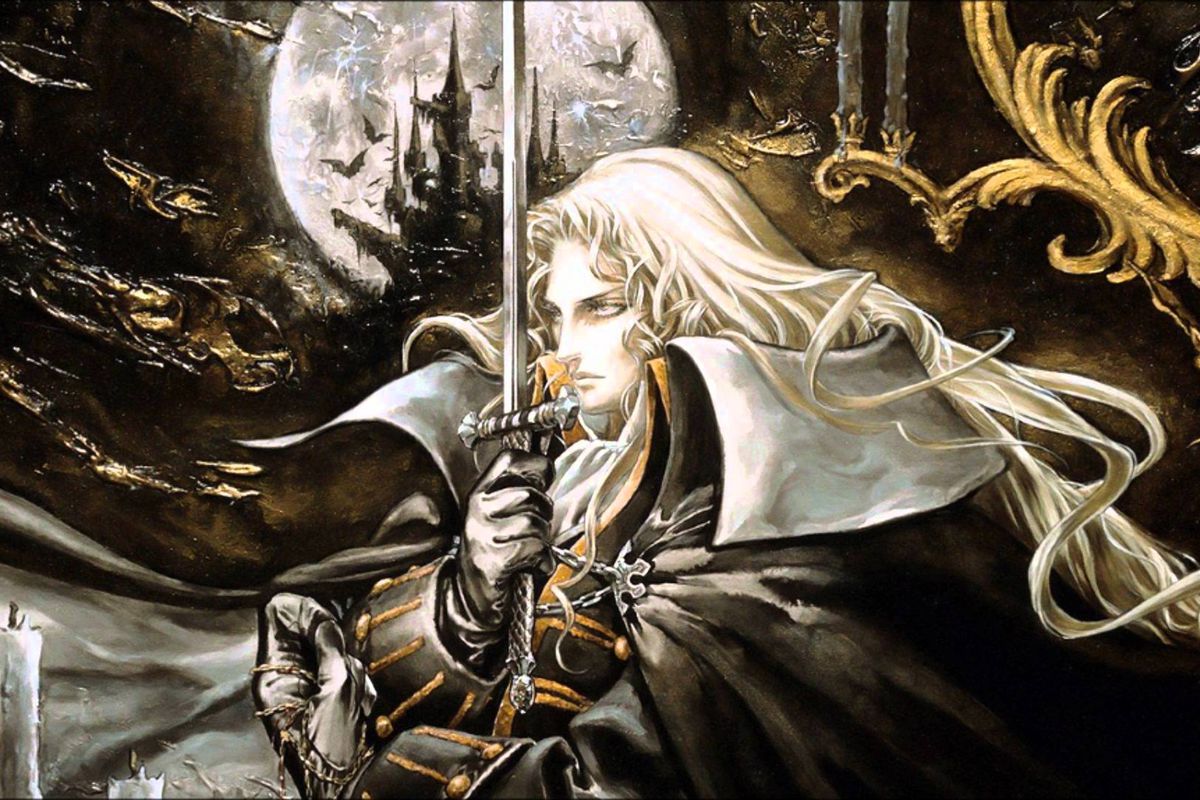
And I won’t sugarcoat it – even as a “Metroidvania,” this game has some issues that keep it from the pantheon, the best of the best. The beginning doesn’t suggest those problems, as Symphony tunes up and feels remarkably special. You start with a duel against Dracula, then you’re thrown Alucard – who is so fabulous that I’m surprised he doesn’t actually sparkle – and everything is all kinds of badass. The move-set? Damn-near perfect, splitting the difference between the floaty quality of Super Metroid and Konami’s traditional “dropping like a rock” physics. The music? So fantastic that I’ll shut up and leave that link there, instead. The visuals? The sprite work stands up incredibly well.
But, a lack of overall focus makes things go awry. Once the developers take their foot off of the gas to give way to the methodical, fill-in-the map exploration that is this game’s calling card, things become a bit muddled. Oh, the castle is fun to explore, but you can hit a dead-end rather quickly. Namely, the infamous “clock block.” Outside of knowing that you play as Alucard, and that there’s an inverted castle, I went into this game blind. Whew, buddy. I won’t ruin it here, in case you are picking the game up for the first time, but that was not a great design choice to slow players down. It wouldn’t have been an elegant idea in 1987, let alone 1997. If you’re slightly impatient like me, you could easily waste 4 hours searching in vain, trying to find the one place you must’ve missed. But there is nothing you missed. The development team wanted to have a laugh on you, because your time is, apparently, not terribly valuable to them.
Still, once you get through that, the game really hits its stride. The castle opens up, new movement mechanics are introduced, everything becomes reachable, and it all clicks into place. At that point, Symphony of the Night is as 10/10 as its reputation suggests.
And then it abruptly ends.

Or, you have to use an optional power-up that you probably forgot you had even acquired in order to find two hidden items to unlock your inverted castle. (This is the one place I truly did smack my head – “oh, this is where Hollow Knight got this shit from.”)
Part of me wishes the game had ended, because the inverted castle is merely decent. It’s an extraordinary idea that worked out, don’t get me wrong. But making a room traversable in either spatial orientation kinda ensures that neither orientation is as great as it could be. And the layout of the rooms? Some of those long-ass corridors are filled with damage-sponge enemies that artificially inflate the overall difficulty. The combat is always very good (the one place it truly does top Super Metroid), but on a first play through, you’re inevitably gonna take a few unnecessary deaths – right before you find the save room. You don’t really find any power-ups that open up the castle further, either, so it ends up feeling like a boss-filled trudge.
You could go back to the “normal” castle and keep looking for items, if that’s your bag, but most of them are fairly useless (although some are hilarious – “discreetly increases height!”). Hell, your wolf form is, too. Combined with the developers general disinterest in your time, the got’cha-moment(s) needed for basic progression, and the cheese-tastic localization, one can’t help but see a bit of a campy winking from Igarashi-san and company. There’s a knowing smirk to this, perhaps even a bit of gaming hipster-ism. Only the cool kids in their skinny jeans know the secrets, you see.
Maybe that’s the point, though. This whole project was something fairly audacious, done by the developer equivalent of the $10 coffee brigade. To take the established Castlevania action framework, double back through Simon’s Quest, embellish with some of Super Metroid’s backtracking tricks, garnish with Zelda’s dual world, and to wrap it all up in a 2D hack ‘n slash RPG with the world’s slickest slide-dodge? Which would release during the coming-out party for 3D gaming? That’s a pretty damn ballsy move.
Maybe that’s why when I think back about playing the game, I can’t help but smile.
Yes, some of the room design can feel a little vanilla. Yes, most of the items aren’t worth collecting. Yes, the back half of the game is technically just padding, really.
But I met one of my gaming heroes, and they didn’t disappoint me. As a jaded old bastard, that says something about the enduring quality here, doesn’t it?
Leave a Reply