
Every time I sit down to write about Tears of the Kingdom, the game either subtly morphs on me, or my opinion shifts from a new discovery. It’s a maddening piece of software. It shouldn’t work, but does. I shouldn’t be so invested in it, but I am. This shouldn’t be the greatest game ever made, but it is.
That there isn’t more joy attached to that last sentence is the oddest thing about Zelda. The most exquisitely designed videogame yet devised, one that feels years ahead of anything else made, should fill me with wonder. And yet, my awe is mostly reserved for what EPD has achieved on a technical level.
This is a clinical miracle of design. That intellectual appreciation, however, seems to block me from experiencing it on an emotional level. It’s like eating food on an analytical level, my mind keeping a scorecard of subtle critiques, when all I want is the emotional satisfaction of eating chicken and yellow rice from my mom’s kitchen.
While the heart pangs, the mind tut-tuts me. “Don’t you understand that Ascend is voodoo? Other games can’t even keep consistent collision detection on a simple mesh for their ‘solid’ ground; it’s 2023 and we’re still falling through maps. Meanwhile, EPD has made this an in-game ability. Other developers can’t get around this glitch, while here we have a four-tiered map — don’t forget the caves! — that you can slither through, from an underworld to sky islands!”
I know, brain. I can’t believe Ascend works. Truly, it was the ah-ha moment for me. I began looking for ways to break the game…but I couldn’t. I’m sure you can, and that someone has, but I looked and looked, and only found several brilliant shortcuts (some obviously intended, others perhaps my own invention). Up until I took that detour, the overworld felt oddly small. The game subtly guides you to towers, which fire you into the sky, which leads to exploring the Skyward Sword-esque islands and seeing some staggeringly beautiful vistas. Jump from those islands, float towards another tower, rinse, repeat. It took me days to fill in Breath of the Wild’s map; here I did it in a scant few hours. Perhaps that’s part of the missing magic — the prior adventure through Hyrule was a grand epic of slow discovery, whereas this game’s suite of enhanced mobility powers doesn’t really allow for that.
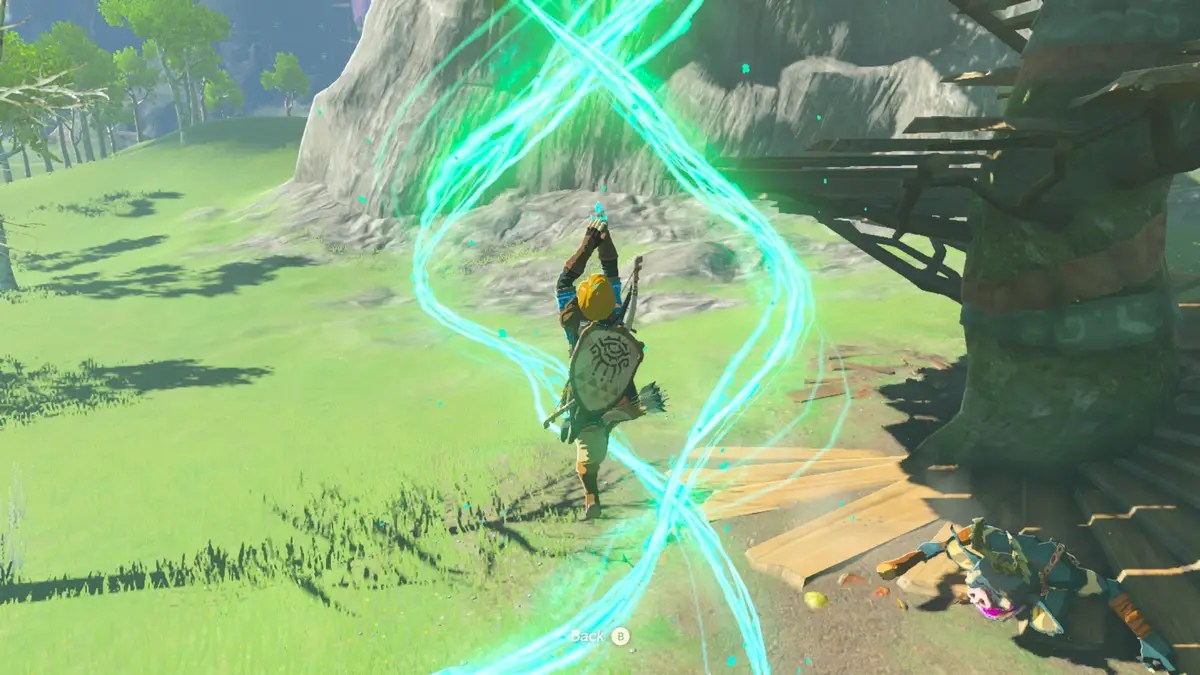
In Tears of the Kingdom, the Nintendo magic is hidden in using your new abilities to explore the map, not merely fill it in. UltraHand has gotten all of the press, but Ascend? It’s the gaming design equivalent of figuring out an optical illusion, that subtle mind wobble, followed by a clattering “ah-ha!” Once you see both the wife and the mother-in-law, you can’t unsee it. Once you see a stone you can Ascend through, you can’t not see a route up that hill using it. It’s like playing in an Escher lithograph. Impossible routes are only a matter of perspective. I’m not sure there’s another developer on the planet that can make this game. Hell, I’m not sure there’s another developer that could make this game 10 years in the future. The graphical fidelity may not surpass the shiniest games of today, and in time the art style may lose a bit of its luster, but on a conceptual level? No one else is even trying to make a game of this ambition.
So what is it? What holds Tears back from being appreciated in its breathtaking totality?
Familiarity, for one. This is an iterative update, and as such, it cannot possibly feel as trailblazing as its predecessor. You only lose your virginity once.
But it’s also down to being so damn smart. Breath of the Wild was a romantic game, tugging at your heart strings and daring you to climb that hill to see the sun set. Tears of the Kingdom is a mathematical game, challenging you to alter your notions of what the limits are in a videogame.
It is utterly brilliant. Perhaps too smart. Because sometimes you don’t want to see the equation that resolves the math.
Sometimes you just want to watch the sun paint the sky.
 Game Witness