
In Kurt Vonnegut’s “Cat’s Cradle,” the semi-satirical religion of Bokonism hits a bit too close to the bone. Vonnegut invented words to encapsulate terms and situations, much in the way some Japanese says too much in one word for a simple English translation. One of those terms is sinookas – the way our lives intertwine in unexpected, lovely, terrible ways.
Were it not for Metroid: Other M, there would have been no online backlash to Yoshio Sakamoto’s branch of the series. Without that backlash, the announcement of a return to the Prime series would not have been met with such a resounding sigh of relief. And without the restarting of Prime 4’s development, there wouldn’t have been an opening for the release of Metroid Dread as a marquee, system-accompanying killer app. The sinookas of Metroid, its tendrils stretching out and around these events, is the reason why a relatively under-performing intellectual property (relative to its mascot status) is the toast of the gaming world right now, the capstone to the Metroidvania renaissance.
It is a deserved moment. Not because Dread is a wholescale rebooting of the franchise – far from it. Instead, Yoshio Sakamoto used this opportunity to double-down on ideas he believed in for the series. While the entire Metroidvania subgenre has used Super Metroid as its lodestar, Sakamoto has insisted on refining and expanding upon the foundation he built in that game’s follow-up, Fusion. Whereas open-ended backtracking is the order of the day for most of today’s genre classics, like Hollow Knight, the Fusion model is best described as curated exploration – linearity isn’t an evil word here, it’s a focus and guide to keep players guessing, but not entirely lost. Dread certainly has a bigger world and map than Fusion (or Super, for that matter), but it is designed in such a way that gently pushes us forward. First gently, then more urgently.
Dread also liberally pulls from the most controversial of all Metroids, Other M. There is no version of this story, of these sinookas, that doesn’t include Team Ninja creating a badass hand-to-hand combat expert out of Samus. Just about everything about the way Samus moves in Dread, from her running animations to her melee counter (which had a trial run in Samus Returns before being perfected here), has a certain feel of Team Ninja’s thumbprint upon it. As does Dread’s camera system. Other M had a cinematic flair for seamless transitions that is shared here. In fact, this is probably the most 3D-feeling 2D game of all time. An interesting symmetry to Other M probably being the most 2D-feeling 3D game of all time.
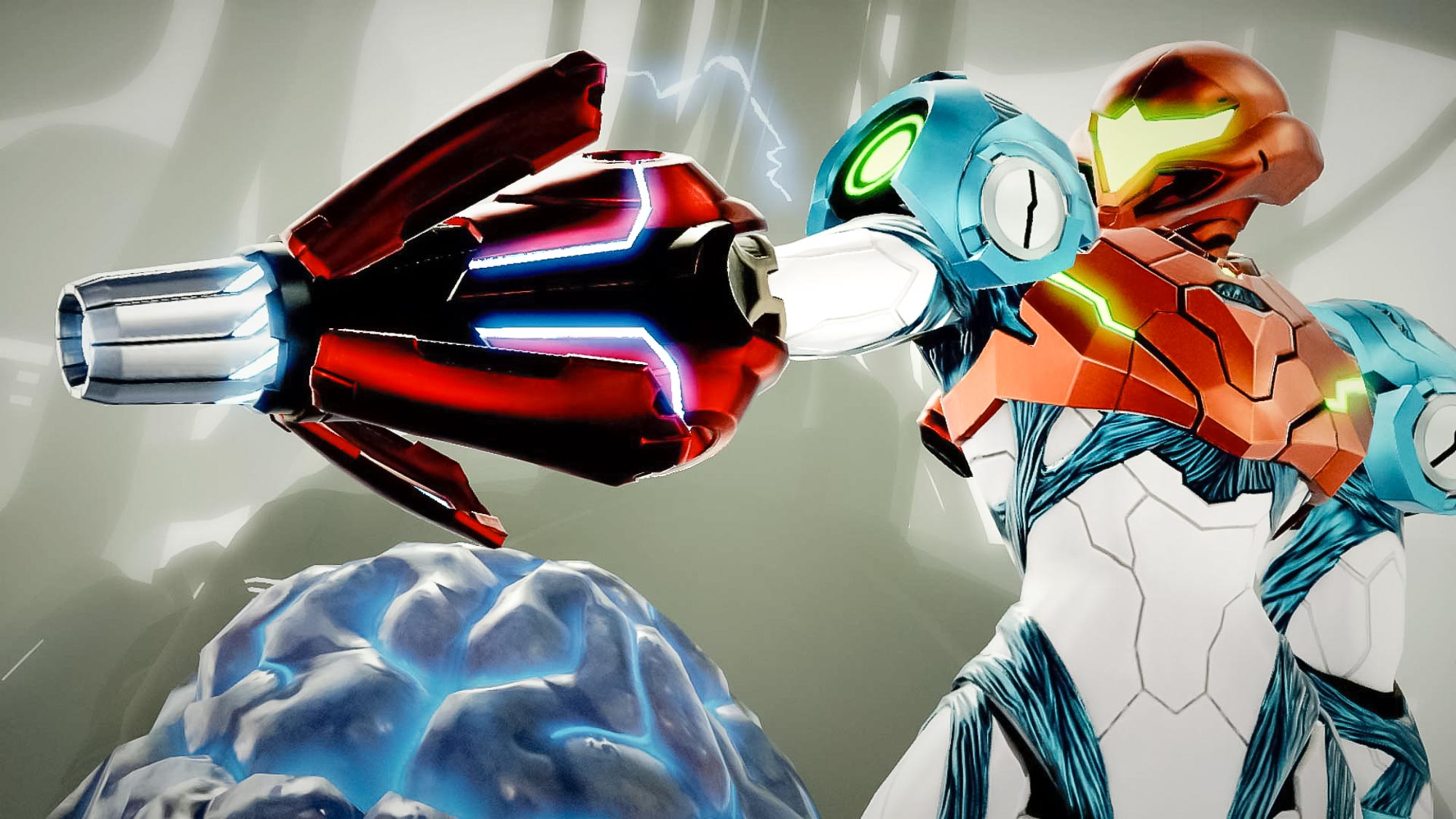
As is par for the course for post-Fusion Metroid, hummable themes have been replaced by ambient sound design. Moments of Alien-like horror are given more gravity than the wonder of exploration. Natural splendor is accounted for, but stark colors and neon punctuate the world. A computer directs you (although this time, with a twist). Dread is not a slave to a design from 1994, and it attempts things that probably didn’t seem possible in 2002 or 2010.
And yet…its ambition is utterly, completely accessible.
Alex and I have discussed the game at length (more on that soon), but a word that kept coming up was “safe.” This is not a wildly experimental, avante-garde piece of game design. It’s a clever distillation of existing ideas. It is the perfect starting point for newcomers to the series. If Ori, Hollow Knight, La Mulana or any modern indie Metroidvania got you interested in the place where it all started, Dread is here to welcome you with open arms.
Perhaps that is why I haven’t quite been in love with it.
Don’t get me wrong, Dread is a fantastic game. It is an exceptionally-designed, powerfully-produced wonder (as well as a knowing middle-finger by Mercury Steam and Sakamoto to anyone who doubted them). But it’s not really for me. It’s for all of the Metroid-curious in the world.
I’ve already seen Dread’s ideas, in some form or another, for almost two decades now. The E.M.M.I. are cool, but the SA-X was scarier. These camera perspective shifts are neat, but they were even better when the camera moved around liberally in a 3D space to frame and re-frame the action. The melee counter feels great, but I could sense dodge before, or counter-attack into a martial-arts kick if I was feeling fancy. These are the sorts of risks I came to expect from non-Prime Metroid.
Yoshio Sakamoto made a normcore game with Dread. This is his thesis for mainsteaming a franchise that hasn’t ever quite gotten over with the masses. If you’ve never really paid close attention to his work before, this moment is for you.
Maybe longtime fans will get theirs next time.
 Game Witness