
Handing out winners and losers for E3 seems like an antiquated idea. But…when Nintendo brings Zelda, an exclusive Atlus JRPG, two Advance War remakes, and one of the great missing Wii U ports (Fatal Frame), they make it pretty easy. Big N blew the roof off of E3.
And yet, what has arguably thrown the most heat is a game no one saw coming – Metroid 5. Dread, if you prefer.
There has been much rejoicing in comments sections across the interwebs. That would be normal if this were any other fandom in the world, but the Metroid fandom isn’t like others. It is curious, to put it mildly, to find such reveling in the reveal of a game that many fans not only weren’t asking for, but didn’t want at all. In the post-Other M world, keeping series co-creator Yoshio Sakamoto as far away as possible from the franchise was a calling card for those who insisted the future of Metroid was a one-way street to the first-person Prime games. (I know, because I debated in these flame wars; you can read a well-sourced pushback to all of this here.) Welcome back to the fold, I suppose, Prime-or-else folks. This wasn’t your handiwork, though.
No, this moment is a victory lap for those who stuck it out, waiting for a project that had become the great white whale of the videogame industry. Dread initially existed as a whisper muttered a full 20 years ago, as Metroid IV was unveiled at E3. The first impressions were not flattering.
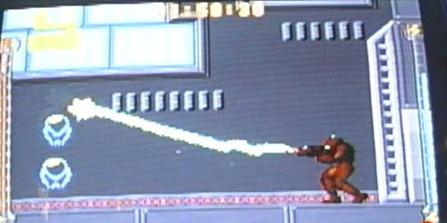
When the following E3 arrived in 2002, and the rechristened Metroid Fusion arrived with pastel graphics, the whispers became audible. “What happened to that game?” Whatever existed in 2001 morphed drastically. That metamorphosis received a dollop of intrigue in 2005, when IGN revealed the existence of a Dread project:
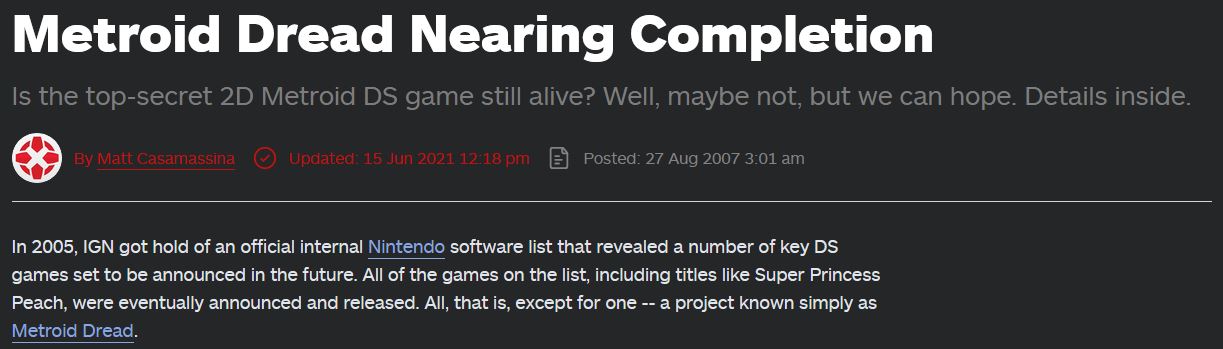
Was that 2001 game actually a Dread prototype? Was Fusion a correction to an underwhelming reveal? Gossip, tales of uncles working for friends in Japan who know a guy…this became the spectral existence of the missing Metroid title. The mystery gained a degree of clarity in 2010, when Sakamoto-san gave us this morsel of info:
“While there actually was a point where some teams were meeting to discuss if it was possible to create a 2D Metroid for DS using a relatively small team size, it’s not something that we ever really announced or thought of as ‘Metroid Dread’. But whenever people bring out that idea, we recognize that the basic concept is something that we can’t say never existed. But at the same time, we can’t of course, make any official comment about a Metroid Dread-like project coming out.”
Yoshio Sakamoto, via Nintendo World Report
Dread was a DS game. Kind of. It was more of an idea – a conceptual framework for a new game that would be made with a small team. In retrospect, this little clarification is quite revealing. It was mostly buried, though. Other M was released, a chunk of the Metroid-should-just-be-Prime-now fandom was put into a spasm of frothy rage, and Dread quietly retreated to the shadows once more.
We would have to wait another 5 years for the breadcrumb trail to pick up. Unseen 64 did the digging in 2015, and gave us some fairly dispiriting news that nearly took us back to 2001-2002.
The parallels were downright eerie – a prototype existed, “Dread” had been dropped from the project name, and the game “literally looked like a port of Fusion on DS.” Oof. It would seem that, whatever Dread was, it couldn’t be made. The concept kept being swept aside.
Then? The furor over Other M gave way to the furor over Metroid Prime: Federation Force, which gave way to the first-person-perspective fandom’s collective sigh of relief at the announcement of Metroid Prime 4. Dread was dead. Hell, 2D Metroid very nearly was. When Samus Returns was revealed at E3 2017, it was relegated to being an announcement at Nintendo Treehouse. A 2D, Sakamoto-helmed Metroid wasn’t even important enough to make it into Nintendo’s main presentation. The game became an even bigger punching-bag when the developer was revealed. “Mercury Steam? The Mirror of Fate guys? Get outta here.”
Sakamoto wasn’t even sure enough mainline Metroid fans existed to buy this type of game anymore.
But a funny thing happened. All of the worry about Yoshio Sakamoto producing another Metroid, and all of the concern over Mercury Steam co-producing with him, was allayed. Samus Returns didn’t suck. In fact, it became a low-key critical darling. Which brings us to the here and now, and crucially, reviewing Sakamoto’s words.
Dread was a tricky bit of business. It required a relatively small development team, because Nintendo was bearish on the success of 2D Metroid, and the chief creative mind behind it knew his vision for the overall series wasn’t necessarily in line with his audience’s appetites:
“We are not the ones that tell people what trends to follow, instead it’s them that tell us what gaming trends we must implement in our games.”
-Yoshio Sakamoto, via Nintendo World Report
How do you build a challenging, oft-shelved project with a small, cheap team, after a fanbase fractured over the authorial voice of the series’ co-creator? It turns out you find a relatively unheralded Spanish developer to work with the guy who pissed off the loudmouths on the web. You modernize the one game in the series that needed it, and use it as a springboard to make vaporware into reality.
Simple, huh?
It probably would have been a lot easier if the 2010 mass freakout crowd wouldn’t have yelled over the rest of us. But, it’s Metroid. When is it ever easy for Samus?
 Game Witness