
It’s easy to take this all for granted.
Here we are, in 2021, with arguably the most Japanese videogame series in the industry taking a victory lap on Nintendo hardware that is selling like hotcakes. It’s obvious now, of course. “Monster Hunter broke through on PS4, and it makes all the sense in the world for Capcom to make one on Switch.” We all saw this coming.
Except we didn’t. Not those of us who were watching the gaming industry a decade ago. It was a different world, as memorably summarized in a Cracked.com image that gained traction before the age of “going viral.”
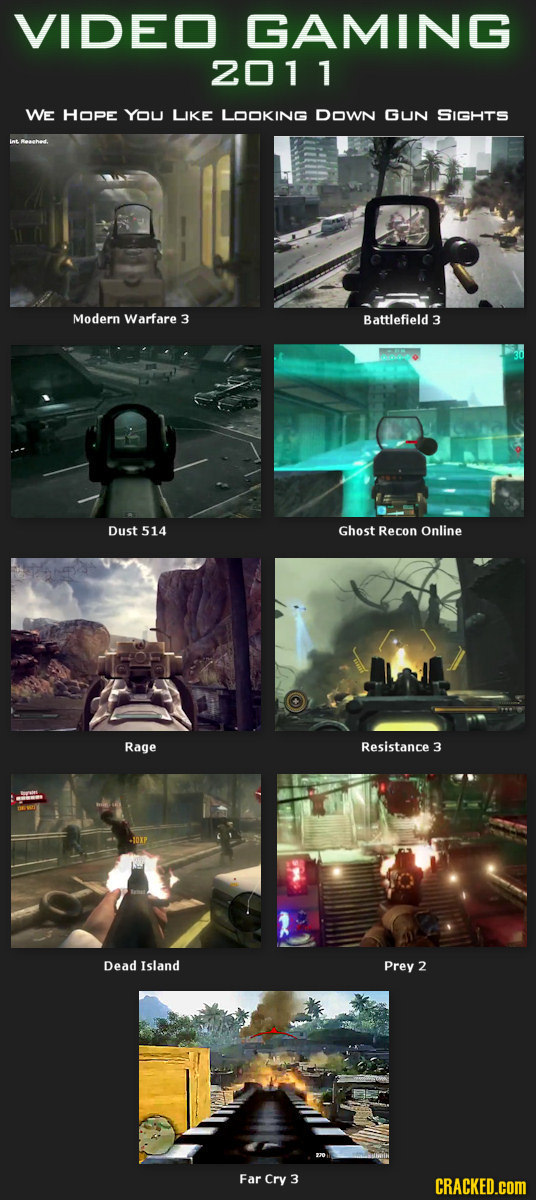
The future was brown, gray, and aimed down the sights of a gun in a first-person shooter. “Cinematic” was the buzzword of the day, and the success of Call of Duty 4 begat a glut of desaturated-color copycats, hitting an apex with 2011’s Modern Warfare 3. This was what we had to look forward to – yet another game of team deathmatch in a slightly shinier Bro Shooter 9. It was grim, kids.
[The supreme irony, of course, is that the launch of Legend of Zelda: Skyward Sword that same year was more of a precursor to the visual future of videogames – abstract, cel shaded, stylized graphics made a comeback. They were even integrated with more photo-realistic styles, with Fortnite becoming as big an IP as any “grimdark” shooter. But that’s another article for another day.]
Yet here we are, hunting giant dino-wyverns with anime swords in a grindy action-RPG that revels in its only-in-a-videogame-ethos in a way “cinematic” shooters never would have imagined becoming a mainstream phenomenon. How the hell did we end up here?
No, really. I’m asking. The renaissance of the Japanese gaming industry seemed unthinkable a decade ago. The idea that huge RPGs would conquer the landscape seemed an antiquated PS1/PS2-era dream. After Nintendo fumbled the Wii U into oblivion, it was hardly obvious that they would rebound with a system that would make a big-budget, third-party game from Capcom a remote possibility. And to pour salt deeper into the wound, Monster Hunter’s critical public breakthrough happened on PS4, imperiling its continued existence on portables. Why spend resources on a portable game that would likely top out with 4 million sales when you could hunt 10-million-plus whales with Sony-exclusivity money?
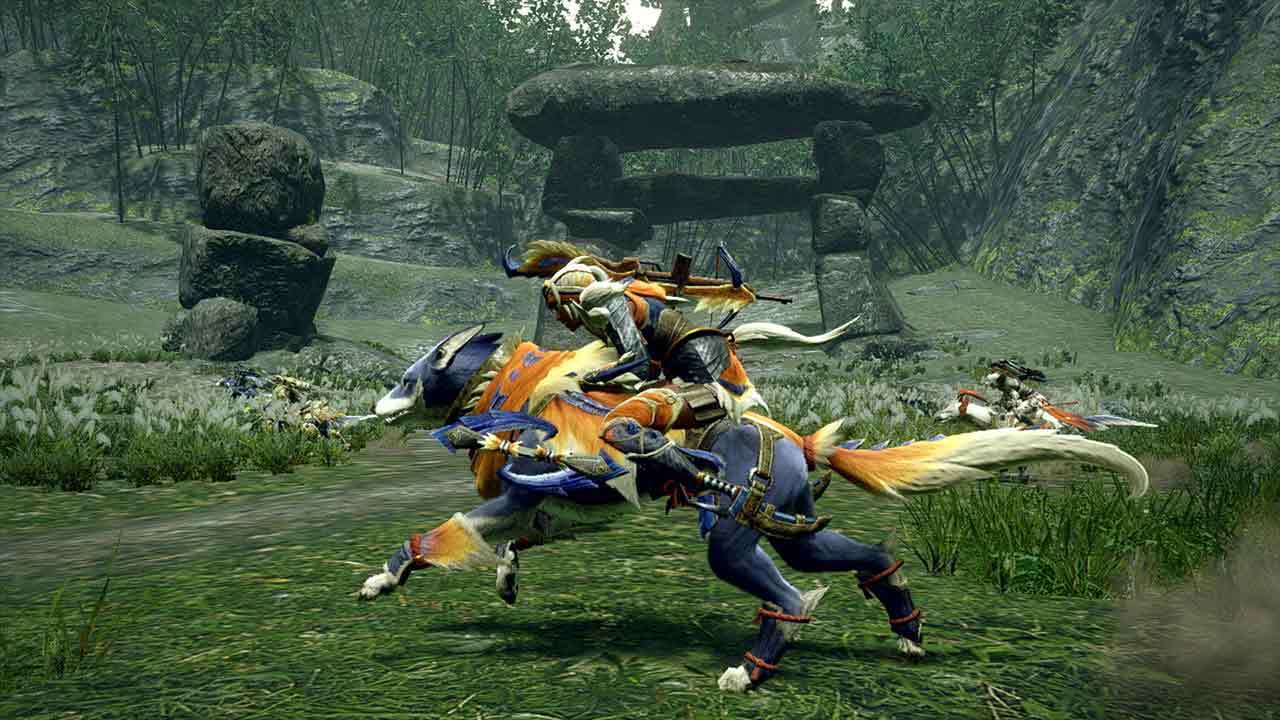
And yet…here we are. Riding doggos in a Japanese-as-hell game for a Nintendo system (with an 84-million-and-growing user base) that’s pulling a lot of duty as a portable device.
A decade ago, Monster Hunter was already a mature series, figuring out if its destiny was at home (like Tri on the Wii) or on-the-go (like MH4 on 3DS). Credit Capcom; they realized the answer was both. They knew they needed to swing for the fences on a home console with a large update to HD visuals, and to also streamline the franchise’s opaque game mechanics that could frustrate newcomers. But crucially, they also understood the need to maintain something more important: the soul of the series. It’s impossible to put your finger on, exactly, but if you’ve played MonHun, you know it when you see it. You feel it, that Pavlovian response to a tail cut, or a perfectly-timed stun. That soul needed a visual refresh, but Capcom reckoned it could still live on a small screen, too. It would have been easy to release a watered-down smartphone game; MonHun-on-the-go could have been a micro-transaction-filled hellscape.
Instead it exists as a vital update to the main series, a blockbuster in its own right.
So enjoy this, fellow nerds. We live in the good timeline. Odds are, the worm will turn. Nothing lasts forever, and evolving tastes could eventually relegate the simple pleasures here (hunting a monster and making a hat out of it) to a dust bin. For now, though? The absurdity of mainstream-Monster Hunter is worth celebrating.
 Game Witness