
“It hasn’t aged well.”
You can see it, right? The scrunched up nose and slightly mournful shadow that crosses a friend’s face. You can replay a game, but not a memory, and revisiting a favorite from your digital childhood has a way of sullying even the most golden recollection. Did you really love this game, or were you merely in love with the idea of it?
Me? I never loved Final Fantasy VII. Hell, a confession: I’ve never even completed a Final Fantasy game. I know, I know. How is that even possible? Outside of watching friends play various entries, and a few dimly-remembered hours of FF IV on the DS, I’ve never really cared about the series.
But a funny thing has happened as I’ve aged: I’ve begun to appreciate the peculiar style of turn-based RPGs that I actively loathed as a younger gamer. Chalk it up to a desire for considered, less twitchy, and more laid-back gameplay. I’m old.
So as the rest of the world is playing the first chapter of its episodic remake, I’ve dug into the original Final Fantasy VII (henceforth FF7). Well, as “original” as one can be when played on the Nintendo Switch, with additions that are either “quality of life” improvements, or plain old “cheat codes,” depending on your point of view. (Options to speed up battle, max-out stats, and turn off random battles are included. So long as these aren’t abused, their net effect is to reduce the need for healing spells/items and ether.)
How has it aged?
Y’know, OK. As someone who was there during the 2D-to-3D transitional era, this game is still…dare I say charming? There’s something about these early 3D games that feels a bit more like digitized craftsmanship. Each scene feels fitted together, sewn in a particular fashion, and then framed as to be viewed in the correct light. At the time of its release, the budget for FF7 was in a league of its own, and it shows. Before the onslaught of “cinematic experiences” in the late 2000s, this game was styled with the eye of a cinematographer. You watch Cloud walk down a dark corridor that is lit just so, only for the camera to take a side-on view as your team hustles up a staircase, then later shift to give you a view out of an elevator. Conrad Hall could have framed some of these shots. The dynamism of the camera is a wonderful surprise here, and when placed up against a modern indie-ish game like Travis Strikes Again, it makes one realize that FF7 has been out of date so long that it’s somewhat back in fashion.
That isn’t to say that the whole visual package is pristine – far from it. This is an old, blurry game with some laughably strange character models. Displayed on a large, modern HD television, things look messy, to be kind (the “remaster” character models also clash with the still-blurry backgrounds). This version of the game is far more acceptable in handheld mode on the Switch. Still, think back to the time of its release. Most people probably played this on a 22″ standard definition TV screen. This must’ve been the closest anyone had ever experienced to “playing a movie,” with a masterful soundtrack to match. (Seriously, the tunes are worthy of their own article.)
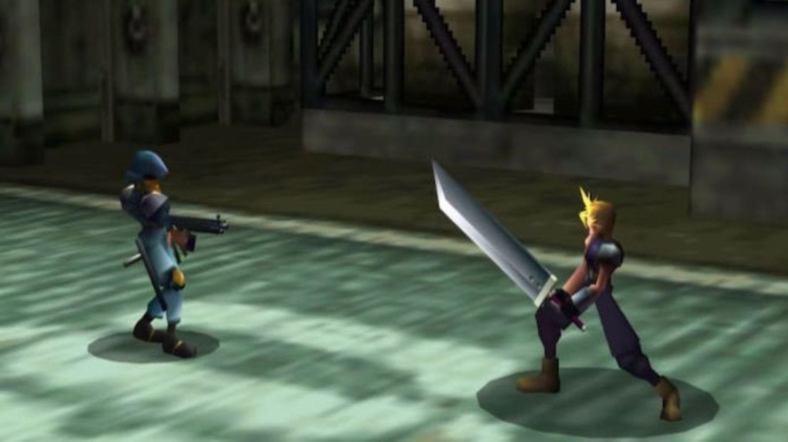
Even the combat has verve and flare. At root, it’s only a slight variation on ATB, but that old blueprint is as rock solid today as it was in 1997. You aren’t starved for options, the Materia system allows customization that laughs in the face of rigid RPG class distinctions, and there’s a layer of strategy on when to unleash a limit-break attack. Is this a complex symphony of intertwining gameplay schemes? No. But it’s smart, easy to pick up, and offers real depth. Plus, while the animations for magic and limit-breaks certainly won’t wow a modern viewer, they’re still a nice visual spice that punctuate battles with some sturm und drang.
It isn’t all flowers, candy, and Aerith, of course. Visual imperfections are expected from a game of this vintage, but there are also some oddball control quirks that make traversal a bit wonky (you can tell a D-pad was still the input method of choice in development). Some of the blurry backgrounds make progress more challenging than it ought to be, ATB can still create a between-attacks waiting game, and leaving random encounters on can irritate even the most hardened JRPG veteran.
Those symptoms of old age are more like crow’s feet, though. FF7 has seen its day come and go, but it still has something to offer, something to say. It’s less a ruin, more a relic.
I have only played through the Midgar section, but thus far? The editors of the new conventional wisdom are wrong. It doesn’t take rose-colored glasses to see that Final Fantasy VII stands up. If not out.
 Game Witness